The Propose and Accept Pattern
The Propose and Accept Pattern
The Propose and Accept pattern demonstrates how to start a bilateral workflow. One party creates a proposal or an invite contract. This gives another party the chance to accept, reject, or renegotiate.
Motivation
It takes two to tango, but one party has to propose. It is no different in the business world. The contractual relationship between two businesses often starts with an invite, a business proposal, a bid offering, etc.
InviteWhen a market operator wants to set up a market, they need to go through an onboarding process in which they invite participants to sign master service agreements and fulfill different roles in the market. Receiving participants need to evaluate the rights and responsibilities of each role and respond accordingly.
ProposeWhen issuing an asset, an issuer is making a business proposal to potential buyers. The proposal lays out what is expected from buyers, and what they can expect from the issuer. Buyers need to evaluate all aspects of the offering, e.g. price, return, and tax implications, before making a decision.
The Propose and Accept pattern demonstrates how to write a Daml program to model the initiation of an inter-company contractual relationship. Daml modelers often have to follow this pattern to ensure that no participant is forced into an obligation.
Implementation
The Propose and Accept pattern in general involves two contracts, the proposal contract and the result contract:
Proposal ContractThe proposal contract can be created from a role contract or any other point in the workflow. In this example, the proposal contract is the proposal contract CoinIssueProposal which the issuer created from the master contract CoinMaster.
template CoinMaster
  with
    issuer: Party
  where
    signatory issuer

    nonconsuming choice Invite : ContractId CoinIssueProposal
      with owner: Party
      controller issuer
      do create CoinIssueProposal
            with coinAgreement = CoinIssueAgreement with issuer; owner
The CoinIssueProposal contract has Issuer as the signatory and Owner as the controller to the Accept choice. In its complete form, the CoinIssueProposal contract should define all choices available to the owner, i.e. Accept, Reject or Counter (re-negotiate terms).
template CoinIssueProposal
  with
    coinAgreement: CoinIssueAgreement
  where
    signatory coinAgreement.issuer
    observer coinAgreement.owner

    choice AcceptCoinProposal
      : ContractId CoinIssueAgreement
      controller coinAgreement.owner
      do create coinAgreement
Once the owner exercises the AcceptCoinProposal choice on the proposal contract to express their consent, it returns a result contract representing the agreement between the two parties. In this example, the result contract is of type CoinIssueAgreement. Note, it has both issuer and owner as the signatories, implying they both need to consent to the creation of this contract. Both parties could be controller(s) on the result contract, depending on the business case.
template CoinIssueAgreement
  with
    issuer: Party
    owner: Party
  where
    signatory issuer, owner

    nonconsuming choice Issue : ContractId Coin
      with amount: Decimal
      controller issuer
      do create Coin with issuer; owner; amount; delegates = []
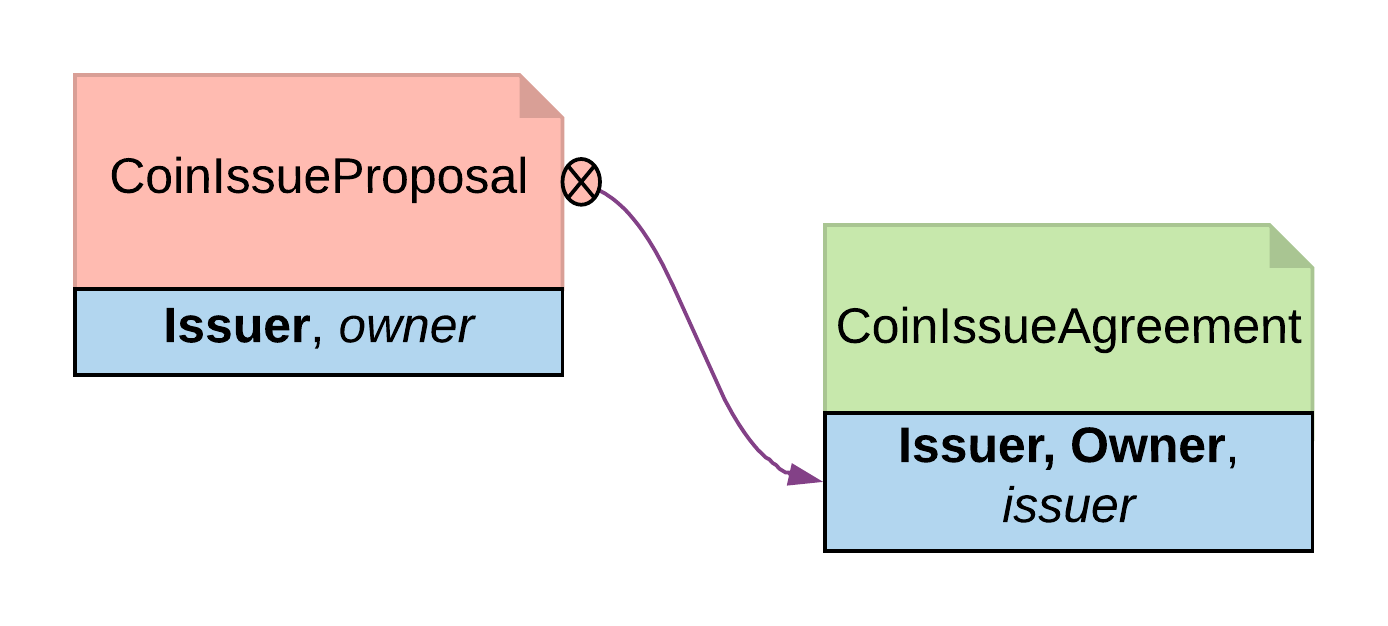
Propose and Accept pattern diagram
Trade-offs
Propose and Accept can be quite verbose if signatures from more than two parties are required to progress the workflow.

