

Synchronizer Operations
This page is a reference for configuring, bootstrapping, and operating synchronizer nodes.
A Synchronizer exposes two main APIs, the Admin API and the Public API, while the Participant Node exposes the Ledger API and the Admin API. In this section, we explain what the APIs do and how they can be configured.
For details on how to configure endpoints and their addresses, ports, keep alive, and so on, see the general API documentation.
All Sequencer Public API configuration parameters have defaults. For example, the default address to listen on is
Note that this configuration is for single-node networks; you cannot add peers. For multi-node networks, refer to the next section.
The
For more details on authentication, visit the secure Synchronizer page.
If TLS is used on the server side with a self-signed certificate, we need to pass the certificate chain during the connect call of the participant. Otherwise, the default root certificates of the Java runtime will be used. An example would be:
However, we suggest keeping the default values.
As mentioned above, an issued token allows the member that provides it during a call to authenticate on public sequencer API services. Therefore, these tokens are sensitive information that must not be disclosed. If an operator suspects that the authentication token for a member has been leaked or somehow compromised, they should use the
This howto assumes familiarity with general Synchronizer concepts. Refer to the Canton overview for more information.
Now you can initialize the centralized Synchronizer as follows:
Instead of using the defaults, you can customize the static Synchronizer parameters. Refer to the parameters configuration section for more information about which static Synchronizer parameters are available and their value.
Now a Participant Node can connect to the Synchronizer via a Sequencer. Check that the Participant Node can use the Synchronizer through a
 All Synchronizer owners must agree on the static Synchronizer parameters in advance. You can achieve that, for example, by exporting and sharing a file containing their definition:
Now create temporary topology stores to bootstrap the Synchronizer’s topology in both Sequencers’ consoles:
Export the Sequencer and Mediator identities from both Sequencers’ consoles:
Import the node identities into the respective temporary topology stores from the respective consoles:
Propose and export the decentralized namespace declaration with the first Sequencer’s signature:
On the second Sequencer’s console, load the first Sequencer’s decentralized namespace declaration, sign it, and share it again:
Generate the Synchronizer bootstrap transactions with the second Sequencer’s signature and share them with the first Sequencer:
On the first Sequencer’s console, load the second Sequencer’s decentralized namespace declaration and Synchronizer bootstrap transactions:
Still on the first Sequencer’s console, generate and re-export the genesis topology. This also merges the signatures from both Sequencers:
On the second Sequencer’s console, load the first Sequencer’s Synchronizer bootstrap transactions, which contain both Sequencers’ signatures:
Bootstrap both Sequencers with the fully authorized initial topology snapshot from the respective consoles:
Now that the Synchronizer has been successfully bootstrapped and the Sequencers initialized, remove the temporary topology stores:
On both Sequencers’ consoles, initialize the Mediators by connecting each of them to the associated Sequencer:
Now the decentralized Synchronizer is completely initialized and a Participant Node is able to operate on this Synchronizer through its Sequencer connection:
All Synchronizer owners must agree on the static Synchronizer parameters in advance. You can achieve that, for example, by exporting and sharing a file containing their definition:
Now create temporary topology stores to bootstrap the Synchronizer’s topology in all four Sequencer nodes’ consoles:
Export the Sequencer and Mediator identities from all four Sequencer nodes’ consoles:
Import the node identities into the respective temporary topology stores from the respective consoles:
Propose and export the decentralized namespace declaration with the first Sequencer’s signature:
On the second Sequencer’s console, load the first Sequencer’s decentralized namespace declaration, sign it, and share it again:
Generate the Synchronizer bootstrap transactions with the second Sequencer’s signature and share them with the first Sequencer:
On the first Sequencer’s console, load the second Sequencer’s decentralized namespace declaration and Synchronizer bootstrap transactions:
Still on the first Sequencer’s console, generate and re-export the genesis topology. This also merges the signatures from both Sequencers:
On the second Sequencer’s console, load the first Sequencer’s Synchronizer bootstrap transactions, which contain both Sequencers’ signatures:
Bootstrap all Sequencers with the fully authorized initial topology snapshot from the respective consoles. For the two Sequencers that are Synchronizer owners, the initial snapshot already exists locally in their respective temporary stores from the Synchronizer bootstrap process:
For the non-owner Sequencers, externally share the initial topology snapshot to enable the assign from genesis state command. In this example, assume the first Sequencer externally shares the initial topology snapshot with the third and fourth Sequencers by sharing a written file:
Now that the Synchronizer has been successfully bootstrapped and the Sequencers initialized, remove the temporary topology stores:
On both Sequencer owners’ consoles, initialize the Mediators by connecting each of them to the associated Sequencer:
Now the decentralized Synchronizer is completely initialized and a Participant Node is able to operate on this Synchronizer through its Sequencer connection:
Now, when a Participant Node attempts to join the Synchronizer, it’s rejected because it’s unknown:
To allow the Participant Node to join the Synchronizer, the Synchronizer owners must authorize it.
First, export the Participant Node’s ID to a string:
Extract the ID of the Participant Node into a string:
Communicate this string to the Synchronizer owners, who import it as follows:
Let all Synchronizer owners authorize the Participant Node:
Check that the Participant Node isn’t active yet:
When issuing the Participant Node Synchronizer permission for a given Participant Node, the Synchronizer owners declare that they agree that the Participant Node joins the Synchronizer. Inspect this declaration:
To activate the Participant Node on the Synchronizer, register the signing keys and the “Synchronizer trust certificate” of the Participant Node (the Participant Node generates this certificate automatically and sends it to the Synchronizer during the initial handshake).
Trigger the handshake again by letting the Participant Node reconnect to the Synchronizer:
Now, check that the Participant Node is active:
You can also confirm that the Participant Node is active with:
Finally, check that the Participant Node is healthy and can use the Synchronizer:
After the configuration is modified, disconnect all the Participant Nodes from the Synchronizer and then restart all nodes.
Then perform the restart:
Once Canton has recovered, use the admin command to set the
This page describes how to enable and configure traffic management on a Synchronizer, and how to inspect and manage the traffic balances of its members.
Inspecting how much traffic a Synchronizer member has from the member’s perspective (for Participant Nodes and Mediator Nodes) is discussed in Manage Node traffic.
If the field
Assuming
Let’s confirm that the traffic management is now enabled by checking the synchronizer parameters again:
Note the
If you only want to check the traffic balance of a specific member, you can use:
Let’s add some traffic for a member, for example,
Now we can submit a command to increase the traffic balance for
Now the traffic balance for
Now let’s run
Observe the traffic balances for the Participants and the Mediator decrease.
For more information on traffic control and its configuration parameters, read the traffic control overview.
This operation prunes processed sequenced events and finalized confirmation response aggregations based on the configured default retention period.
This value is seven days by default; you can configure it as follows:
The Mediator retention period applies only to the Mediator’s own stored data; it does not affect how long Sequencer clients can be offline.
To choose another value, you can either change the config above or directly specify a retention period with the command
This command uses the configured Sequencer default retention period to compute the timestamp from which to prune sequenced events and returns a description of what was pruned.
This value is seven days by default; you can configure it as follows:
Alternatively, you can directly specify a retention period with the command
The status contains the latest acknowledgement timestamp for all active clients, and you can check the computed safe pruning point by calling
Setting
You can also set up scheduled automatic pruning for the BFT Orderer using the commands shown below as well as the ones explained in the automatic pruning reference.
Only the active mediator node replica has to be initialized through the synchronizer bootstrap commands. The passive replicas observe the initialization via the shared database.
Further replicas can be started at runtime without any additional setup. They remain passive until the current active mediator node replica fails.
If the synchronizer runs on BFT sequencers, wait until the ordering topology of the remaining sequencers no longer lists the decommissioned sequencer before stopping it; you can check that with the
All Synchronizer owners must agree on the static Synchronizer parameters in advance. You can achieve that, for example, by exporting and sharing a file containing their definition:
Now create temporary topology stores to bootstrap the Synchronizer’s topology in both Sequencers’ consoles:
Export the Sequencer and Mediator identities from both Sequencers’ consoles:
Import the node identities into the respective temporary topology stores from the respective consoles:
Propose and export the decentralized namespace declaration with the first Sequencer’s signature:
On the second Sequencer’s console, load the first Sequencer’s decentralized namespace declaration, sign it, and share it again:
Generate the Synchronizer bootstrap transactions with the second Sequencer’s signature and share them with the first Sequencer:
On the first Sequencer’s console, load the second Sequencer’s decentralized namespace declaration and Synchronizer bootstrap transactions:
Still on the first Sequencer’s console, generate and re-export the genesis topology. This also merges the signatures from both Sequencers:
On the second Sequencer’s console, load the first Sequencer’s Synchronizer bootstrap transactions, which contain both Sequencers’ signatures:
Bootstrap both Sequencers with the fully authorized initial topology snapshot from the respective consoles:
Now that the Synchronizer has been successfully bootstrapped and the Sequencers initialized, remove the temporary topology stores:
On both Sequencers’ consoles, initialize the Mediators by connecting each of them to the associated Sequencer:
Now the decentralized Synchronizer is completely initialized and a Participant Node is able to operate on this Synchronizer through its Sequencer connection:
All Synchronizer owners must agree on the static Synchronizer parameters in advance. You can achieve that, for example, by exporting and sharing a file containing their definition:
Now create temporary topology stores to bootstrap the Synchronizer’s topology in all four Sequencer nodes’ consoles:
Export the Sequencer and Mediator identities from all four Sequencer nodes’ consoles:
Import the node identities into the respective temporary topology stores from the respective consoles:
Propose and export the decentralized namespace declaration with the first Sequencer’s signature:
On the second Sequencer’s console, load the first Sequencer’s decentralized namespace declaration, sign it, and share it again:
Generate the Synchronizer bootstrap transactions with the second Sequencer’s signature and share them with the first Sequencer:
On the first Sequencer’s console, load the second Sequencer’s decentralized namespace declaration and Synchronizer bootstrap transactions:
Still on the first Sequencer’s console, generate and re-export the genesis topology. This also merges the signatures from both Sequencers:
On the second Sequencer’s console, load the first Sequencer’s Synchronizer bootstrap transactions, which contain both Sequencers’ signatures:
Bootstrap all Sequencers with the fully authorized initial topology snapshot from the respective consoles. For the two Sequencers that are Synchronizer owners, the initial snapshot already exists locally in their respective temporary stores from the Synchronizer bootstrap process:
For the non-owner Sequencers, externally share the initial topology snapshot to enable the assign from genesis state command. In this example, assume the first Sequencer externally shares the initial topology snapshot with the third and fourth Sequencers by sharing a written file:
Now that the Synchronizer has been successfully bootstrapped and the Sequencers initialized, remove the temporary topology stores:
On both Sequencer owners’ consoles, initialize the Mediators by connecting each of them to the associated Sequencer:
Now the decentralized Synchronizer is completely initialized and a Participant Node is able to operate on this Synchronizer through its Sequencer connection:
Now, when a Participant Node attempts to join the Synchronizer, it’s rejected because it’s unknown:
To allow the Participant Node to join the Synchronizer, the Synchronizer owners must authorize it.
First, export the Participant Node’s ID to a string:
Extract the ID of the Participant Node into a string:
Communicate this string to the Synchronizer owners, who import it as follows:
Let all Synchronizer owners authorize the Participant Node:
Check that the Participant Node isn’t active yet:
When issuing the Participant Node Synchronizer permission for a given Participant Node, the Synchronizer owners declare that they agree that the Participant Node joins the Synchronizer. Inspect this declaration:
To activate the Participant Node on the Synchronizer, register the signing keys and the “Synchronizer trust certificate” of the Participant Node (the Participant Node generates this certificate automatically and sends it to the Synchronizer during the initial handshake).
Trigger the handshake again by letting the Participant Node reconnect to the Synchronizer:
Now, check that the Participant Node is active:
You can also confirm that the Participant Node is active with:
Finally, check that the Participant Node is healthy and can use the Synchronizer:
After the configuration is modified, disconnect all the Participant Nodes from the Synchronizer and then restart all nodes.
Then perform the restart:
Once Canton has recovered, use the admin command to set the
This page describes how to enable and configure traffic management on a Synchronizer, and how to inspect and manage the traffic balances of its members.
Inspecting how much traffic a Synchronizer member has from the member’s perspective (for Participant Nodes and Mediator Nodes) is discussed in Manage Node traffic.
If the field
Assuming
Let’s confirm that the traffic management is now enabled by checking the synchronizer parameters again:
Note the
If you only want to check the traffic balance of a specific member, you can use:
Let’s add some traffic for a member, for example,
Now we can submit a command to increase the traffic balance for
Now the traffic balance for
Now let’s run
Observe the traffic balances for the Participants and the Mediator decrease.
For more information on traffic control and its configuration parameters, read the traffic control overview.
This operation prunes processed sequenced events and finalized confirmation response aggregations based on the configured default retention period.
This value is seven days by default; you can configure it as follows:
The Mediator retention period applies only to the Mediator’s own stored data; it does not affect how long Sequencer clients can be offline.
To choose another value, you can either change the config above or directly specify a retention period with the command
This command uses the configured Sequencer default retention period to compute the timestamp from which to prune sequenced events and returns a description of what was pruned.
This value is seven days by default; you can configure it as follows:
Alternatively, you can directly specify a retention period with the command
The status contains the latest acknowledgement timestamp for all active clients, and you can check the computed safe pruning point by calling
Setting
You can also set up scheduled automatic pruning for the BFT Orderer using the commands shown below as well as the ones explained in the automatic pruning reference.
Only the active mediator node replica has to be initialized through the synchronizer bootstrap commands. The passive replicas observe the initialization via the shared database.
Further replicas can be started at runtime without any additional setup. They remain passive until the current active mediator node replica fails.
If the synchronizer runs on BFT sequencers, wait until the ordering topology of the remaining sequencers no longer lists the decommissioned sequencer before stopping it; you can check that with the
Setup order
- Configure — Write Canton configs for sequencer/mediator APIs, sequencer backend, and TLS (sections below).
- Start — Start the synchronizer nodes with those configs.
- Bootstrap — Initialize the synchronizer topology (see Bootstrap a Synchronizer).
- Connect — Connect participants/validators and verify.
- Operate — Day-2 tasks such as adding nodes, traffic, pruning, HA, and backup and restore.
Configure Synchronizer APIs
For an end-to-end dedicated synchronizer walkthrough that starts with configuration, see Deploying a Dedicated Synchronizer.
Configure Sequencer Public API
The Sequencer Public API provides the services to other nodes to connect, authenticate, and exchange messages with a Synchronizer. To learn more about the Sequencer’s role, visit the Sequencer overview page. Configure the Public APIpublic-api under a Sequencer node configuration:
127.0.0.1. To find out more about the parameters, check the reference documentation.
Configure Sequencer Admin API
The Sequencer Admin API can be configured in the standard way under the Sequencer node configuration (at the same level as the Public API).Configure Mediator Admin API
The Mediator Admin API can be configured in the standard way under the Mediator node configuration:Configure Sequencer Backend
The following page describes the basics of configuring Sequencer backends. For more advanced configuration, refer to the following sections:
- High availability
- Pruning
- Optimization
Database Sequencer
The Database Sequencer is currently unsupported and should not be configured.BFT Sequencer
Minimal BFT Sequencer backend configuration
To use the Byzantine Fault Tolerant (BFT) Sequencer, set thetype parameter to BFT under `sequencer`:
Configure initial peers (optional)
If the network contains more than one node, configure the server endpoint underinitial-network. There, you can also configure peer endpoints, or do so using admin commands later. Pre-configuring the peer endpoints reduces the number of manual configuration steps, which saves time, reduces errors, and accelerates the deployment process.
address and port pair under server-endpoint make up an endpoint where the BFT Sequencer’s gRPC server listens. If the port is not specified, the operating system chooses one for you. The external-address and external-port form an externally available endpoint that other peers can connect to. Usually, the external-address is the domain name of a reverse proxy that points to the listening endpoint. The external endpoint must be configured correctly for clients to successfully authenticate the server.
Transport Layer Security (TLS) is enabled by default for the external endpoint and peer endpoints. For simplicity, it is disabled in the config example. However, it is recommended to configure it in the standard way with:
For more details on the
tlsunderserver-endpointfor the internal server endpointexternal-tls-configunderserver-endpointfor the external endpointtls-configunderpeer-endpointsfor peer endpoints
initial-network configuration, check the reference documentation.
Configure authentication (optional)
Authentication is enabled by default. It can be configured withendpoint-authentication under initial-network (at the same level as server-endpoint):
Configure dedicated storage (optional)
To use dedicated storage, configurestorage under config as for the top-level Sequencer storage configuration.
While the BFT Sequencer defaults to using the top-level Sequencer storage, configuring dedicated storage offers greater flexibility. It allows you to:
- Support distinct data read and write patterns with different database backends and settings
- Separate backups
Optimize the BFT orderer
System resources
Available system resources can affect the performance of the BFT orderer in multiple ways:- Node resources:
- CPU: affects general processing and particularly cryptographic operations.
- Memory: affects general processing and particularly the ability of a node to cope with bigger networks
- Disk I/O: affects the performance of an orderer’s database operations.
- Network adapter performance: affects general network throughput and latency.
- Network resources:
- Network bandwidth: affects message dissemination times and can directly affect ordering latency.
- Network latency: affects message propagation times and can directly affect ordering latency.
Dimensions
The size of the network and the characteristics of the ordering requests can also affect performance and resource usage:- Number of Sequencer Nodes: the ISS protocol scales in the number of nodes up to node saturation.
- Request Size: larger requests can lead to increased processing times, however the dissemination sub-protocol, when running on a high-bandwidth network, reduces the overall effect of request size up to node saturation.
Synchronizer parameters
Some general Synchronizer parameters can also affect the performance of the BFT orderer:- Topology change delay: as for the Sequencer in general, bigger values reduces the chance of waiting for the topology processor to complete computing the requested topology snapshot.
Configuration
Some configuration parameters can affect performance and resource usage of the BFT orderer and are discussed below. Refer to Configure Sequencer Backend for general information on how to configure the orderer.- Epoch length: epoch transitions’ overhead may be significant, because all nodes need to wait for the whole epoch’s blocks to be complete to detect potential topology changes. Increasing the epoch length reduces the frequency of these transitions, at the cost of slower reaction to topology changes.
- Minimum and maximum requests in batches, maximum batch creation interval: larger and less frequent batches increase throughput, at the cost of increased latency.
- Maximum batches in blocks: larger block sizes increase throughput, at the cost of increased latency.
- Leader selection policy: by default, failing leaders are blacklisted for a certain period. Disabling blacklisting may improve performance in stable networks, at the cost of reduced performance and resilience during node and network instability.
- Consensus empty block creation timeout: the orderer creates empty blocks after a certain timeout in the absence of ordering traffic so that sequencing time does not lag too much behind median wall clock time. Reducing this timeout may make sequencing timestamps closer to wall clock time, at the cost of increased resource usage.
- Maximum mempool queue size: larger values reduce backpressure on clients submitting requests, at the cost of increased memory usage, load, and ordering latency.
- Maximum number of unordered batches per node: larger values allow peers to disseminate more data before it must be ordered, at the cost of additional storage and memory usage.
- Storage: using fast, dedicated storage for the orderers’ databases improves overall performance.
- Batch aggregator: by default batch aggregation is enabled with a default configuration for all database insert operations. Tuning the batch aggregator’s parameters may improve performance depending on the workload.
- Dedicated execution context divisor: if set, a dedicated execution context is created for the orderer node, with a thread pool size equal to the number of available processors divided by the divisor. Setting this parameter may improve performance under high load, at the cost of increased resource usage.
Secure Synchronizer APIs
Sequencer Public API
Public API
The synchronizer configuration requires the same configuration of theAdmin API as the participant. Next to the Admin API, we need to configure the Public API, which is the API where all participants connect.
TLS Encryption
As with the Admin API, network traffic can (and should) be encrypted using TLS. This is particularly crucial for the Public API. An example configuration section which enables TLS encryption and server-side TLS authentication is given by:Server Authentication
Canton has two ways to perform server authentication to protect from man-in-the-middle attacks: TLS and the synchronizer id. If TLS is used on the Public API as described above, TLS also takes care of server authentication. This is one of the core functions of TLS. Server authentication can also be performed by the synchronizer operator passing their synchronizer identity to the participant node operator, and checking that the identity matches that reported by the synchronizer to the participant node. Like all nodes, the synchronizer has an identity that corresponds to the fingerprint of its namespace root key. It reports its identity to connecting participant nodes and signs all its messages with keys authorized by that namespace root key on the topology ledger. Assuming no key compromises, this gives participants a guarantee that the reported identity is authentic. The synchronizer id of the sole connected synchronizer can be read out using console commands like:Client Authentication
Unlike the ledger or Admin API, the Public API uses Canton’s cryptography and topology state for client authentication rather than mutual TLS (mTLS). Clients need to connect to the Public API in several steps:- The client calls the
SequencerConnectServiceto align on Canton Protocol versions and obtain the synchronizer id. - During the first connection, the client registers by sending its minimal topology state (identity, key delegations, public keys) to the sequencer.
- The client calls the
SequencerAuthenticationServiceto authenticate using a challenge-response protocol and get an access token for the other sequencer services. - The client connects to the main
SequencerServiceusing the access token from 3.
SequencerAuthenticationService responds with a time-limited token which can be used to authenticate more cheaply on the other Public API services.
This authentication mechanism for the restricted services is built into the public sequencer API. You don’t need to do anything to set this up; it is enforced automatically and can’t be turned off.
The expiration of the token generated in step 3 is valid for one hour by default. The nodes automatically renew the token in the background before it expires. The lifetime of the tokens and of the nonce can be reconfigured using
logout console command to immediately revoke all valid tokens of that member and close the sequencer connections. The legitimate member automatically reconnects and obtains new tokens through the challenge-response protocol described above.
The command is slightly different depending on whether the member is a participant or a mediator, for example:
Replace with references to the commands. #22919
Bootstrap a Synchronizer
Complete API, sequencer backend, and TLS configuration, then start the nodes, before bootstrapping.
Set up a centralized Synchronizer
In a centralized Synchronizer, the operator has access to all Sequencer and Mediator nodes. A centralized Synchronizer is the simplest to set up and manage, but it assumes that a single fully trusted entity owns and operates the Synchronizer. You can bootstrap a centralized Synchronizer by specifying a single owner and asynchronizerThreshold of 1. This respectively means that only that owner can authorize topology changes on the Synchronizer, and that one signature is sufficient for that.
First, make sure that the nodes are fresh and haven’t yet been initialized:
ping command:
Set up a decentralized Synchronizer
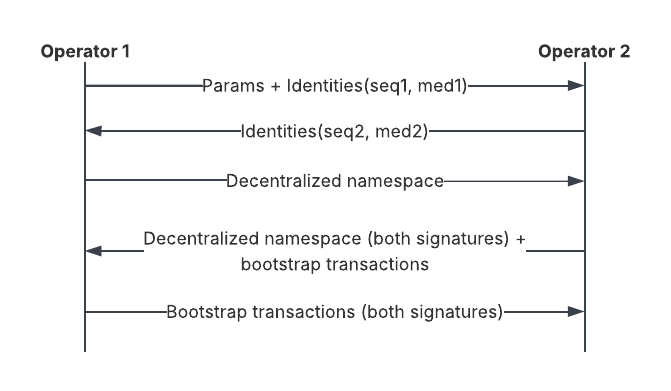
This subsection covers the most frequent case where distinct operators manage decentralized Synchronizer nodes on behalf of the respective owners. This also means that they’re managed from separate console environments. In this case, the bootstrapping process must be coordinated in lockstep between the Synchronizer nodes, with the coordination and exchange of data happening through secure communication channels. As an overview, to bootstrap a decentralized Synchronizer with separate consoles, operators:- Fix the initial parameters.
- Exchange Synchronizer identities.
- Collectively create a decentralized namespace (see the Canton overview for more information); each operator:
- Signs the bootstrapping topology transactions.
- Exchanges the bootstrapping topology transactions with other operators.
- Initializes their Synchronizer nodes.
Before proceeding, ensure that all of the nodes in the decentralized Synchronizer are started.
Set up a decentralized Synchronizer with a subset of Sequencers as owners
The previous subsection describes how to bootstrap a decentralized Synchronizer using multiple Sequencers that are all Synchronizer owners. This subsection describes how to bootstrap a decentralized Synchronizer using multiple Sequencers when only a subset of Sequencers are Synchronizer owners. Similar to the previous subsection, distinct operators may manage different Synchronizer nodes from separate console environments. The bootstrapping process must be coordinated in lockstep between the Synchronizer nodes, with the coordination and exchange of data happening through secure communication channels. This how-to uses four Sequencer nodes and two Mediator nodes. Only two of the Sequencer nodes (the first and second) are Synchronizer owners, and all four Sequencer nodes are managed by distinct operators. Although this how-to shares many bootstrapping commands in common with the previous subsection, there are subtle differences showing the commands that owner and non-owner Sequencer nodes should perform, respectively.Before proceeding, ensure that all of the nodes in the decentralized Synchronizer are started.
Bootstrap a permissioned Synchronizer
The first layer of Synchronizer security is restricting access to the Public API network endpoints of the Sequencers. This can be done using standard network tools such as firewall rules and virtual private networks. Individual Synchronizers can be open, allowing any Participant with a connection to a Sequencer node to join and participate in the network, or permissioned, in which case the Synchronizer owners need to explicitly authorize a Participant before it can register with the Synchronizer and use it. While the Canton architecture is designed to be resilient against malicious Participant Nodes, explicitly restricting which Participant Nodes can join the network constitutes an effective second line of defense. This subsection explains how to make a decentralized Synchronizer permissioned. For simplicity, it assumes a single trusted operator accessing all nodes from a single console environment. First, let all Synchronizer owners set theonboardingRestriction dynamic Synchronizer parameter to RestrictedOpen:
Propagating and processing topology proposals may require some time, so you may have to retry before the submission authorization is visible.
Add New Nodes
Add a new Sequencer to a distributed Synchronizer
You can either initialize Sequencers as part of the regular distributed synchronizer bootstrapping process, or dynamically add a new Sequencer at a later point as described in this section. The reverse procedure is documented in the Sequencer decommissioning section.Database Sequencer
The Database Sequencer is currently unsupported.BFT Sequencer
- Assuming that at least one existing Sequencer is accessible, prepare a new Sequencer and make sure it’s running.
-
Run the following
bootstrapcommand using instance references of the new Sequencer, the existing Sequencer, and the owners of the current Synchronizer: -
Set up new connections in either or both directions for all Sequencers using the following commands:
For the newly-onboarded Sequencer, the endpoints can be configured as part of the initial network.
-
Wait for the new Sequencer to get initialized:
confirmationResponseTimeout and mediatorReactionTimeout dynamic synchronizer parameters with a default of 30 seconds each) before connecting nodes to a newly-onboarded Sequencer.
If you encounter issues, refer to the troubleshooting guide.
For details on the necessary admin commands, check the reference documentation.
Use separate consoles
Similarly to initializing a distributed synchronizer with separate consoles, dynamically onboarding new Sequencers can be achieved in separate consoles as follows:Add a new Mediator to a distributed Synchronizer
You can either initialize Mediators as part of the regular distributed synchronizer bootstrapping process, or dynamically add a new Mediator at a later point as described in this section.- Prepare a new Mediator node and make sure it’s running.
-
Save the new Mediator’s identity and load it to relevant Sequencers:
-
Propose a new Mediator state with active Mediators including the newly-onboarding Mediator:
-
Initialize the new Mediator:
Manage dynamic Synchronizer parameters
In addition to the static Synchronizer parameters that you specify during Synchronizer bootstrap, you can change some parameters at runtime ( while the Synchronizer is running); these are referred to as
dynamic synchronizer parameters. When the Synchronizer is bootstrapped, the default values are used for the dynamic Synchronizer parameters.Get dynamic Synchronizer parameters
You can get the current parameters on a Synchronizer you are connected to using the following command:Change dynamic Synchronizer parameters
You can set several dynamic parameters at the same time:
When increasing
max request size, the sequencer nodes need to be restarted for the new value to be taken into account.Recover from too-small max request size
MaxRequestSize is a dynamic parameter. This parameter configures both the gRPC channel size on the Sequencer node and the maximum size that a Sequencer client is allowed to transfer.
If the parameter is set to a very small value (roughly under 30kb), Canton can crash because all messages are rejected by the sequencer client or by the sequencer node. This cannot be corrected by setting a higher value within the console, because this change request needs to be sent via the sequencer and will also be rejected.
To recover from this crash, you need to configure override-max-request-size on both the Sequencer node and all Sequencer clients.
This means you need to modify both the Synchronizer and the Participant Node configuration as follows:
maxRequestSize value, then delete the added configuration in the previous step, and finally perform the restart again.
Sequencer Traffic Management
Currently traffic management is supported only on Byzantine Fault Tolerant (BFT) Synchronizers.
Enable traffic management on a Synchronizer
Traffic management can be enabled or disabled on an existing Synchronizer via adjusting its dynamic synchronizer parameters. Please refer to the Change dynamic synchronizer parameters for more details. First let’s check the current traffic management status of a Synchronizer:trafficControl of type TrafficControlParameters is not set (absent in the output above) or has enforceRateLimiting set to false then the traffic management is inactive.
To enable traffic management, you update the dynamic synchronizer parameters, setting the TrafficControlParameters with the
enforceRateLimiting = true and specifying desired values for the other parameters documented in configuration class Scaladoc reference.
If you are using a Synchronizer with multiple owners, you need to ensure that the command to enable traffic management is submitted by at least the configured threshold of owners.
sequencer1 being the only synchronizer owner, run the following command to enable traffic management:
traffic control in the output above.
Check the latest traffic balances of Synchronizer members
One can interactively inspect and modify the traffic balances of Synchronizer members using the Canton console commands undersequencer.traffic_control.
To inspect the traffic balances of all members of a Synchronizer, you can use the following command:
Top up the traffic balance for a Synchronizer member
Traffic balance entitlements of members are decided by an external workflow and communicated via submitting the same traffic balance via one or multiple Sequencers.
Top ups must be submitted by a quorum of Sequencers to become effective. This is configured by the
threshold parameter of the SequencerSynchronizerState topology mapping.participant1. First we need to know the current serial (a per-member monotonically increasing PositiveInt), which corresponds to the last traffic balance top up for that member.
participant1 by newBalance:
participant1 has been updated. You can verify this by checking the traffic state again:
ping between participants and observe the traffic consumption:
Synchronizer Pruning
Prune the Mediator state
You can set up scheduled automatic pruning for each of your Mediators as explained in the automatic pruning reference. You can also directly prune the Mediator without using a schedule by calling the following command:mediator.pruning.prune_with_retention_period or even the exact timestamp to prune at, using mediator.pruning.prune_at.
Prune the Sequencer state
You can prune the Sequencer by calling the following command:sequencer.pruning.prune_with_retention_period or even the exact timestamp to prune at, using sequencer.pruning.prune_at.
Unblock pruning due to inactive sequencer members
All Sequencer clients, such as Participants or Mediators, periodically acknowledge the timestamp of the latest event they have received from the Sequencer. These acknowledgements, which all Sequencers can see, allow the Sequencers to compute the highest timestamp that all clients have achieved. This timestamp serves as a safe pruning point. You can check the Sequencer pruning status as follows:status.safePruningTimestamp. The Sequencer can only perform pruning earlier than that point. Otherwise, one or more clients would be unable to continue operation.
If a Sequencer client goes inactive for some time, then all Sequencers are blocked from pruning past this client’s latest acknowledged timestamp. To unblock a Sequencer from pruning at more recent timestamps, either the client must come back and acknowledge newer events or you must disable that client on the Sequencer.
The Sequencer has force-prune commands. The difference between these and the regular prune commands is that the force-prune commands disable members that are preventing pruning from happening at the given timestamp. A disabled member can no longer connect to that Sequencer, so the retention period used for force-pruning limits how long a participant or mediator can be offline. Any pruning, forced or not, also limits how old a backup a participant or mediator can be restored from. Once the Sequencer has pruned the events the restored node missed, the node can’t catch up. Pick a retention period at least as long as the longest outage or the oldest backup you need clients to recover from. On the Global Synchronizer, this limit is 30 days; see Restoring a validator from backups.
You can force prune at a given timestamp as follows:
dryRun to true produces a list of the clients that would be disabled, if any, as part of the operation, without actually performing the pruning. To perform the pruning operation, run it with dryRun set to false.
If you’ve identified a problematic client you don’t need to serve, you can directly disable it by calling the repair command repair.disable_member(client).
Note that when you disable a client on a Sequencer, this is a local operation; the client is still active on other Sequencers that have not performed the same operation.
BFT Orderer Pruning
The BFT Orderer layer of the Sequencer is where distributed consensus on the order of transactions is reached across all Sequencer nodes. It has its own separate set of database tables and different considerations regarding pruning. The BFT Orderer serves ordered events up to the Sequencer layer, which stores them and subsequently serves them to Sequencer clients. The BFT Orderer also needs to retain this data after it is served to the Sequencer layer, because it may need to assist other BFT Orderer nodes that are behind in catching up. You must pick a pruning retention period long enough for BFT Orderer nodes to be able to catch up after crashing and coming back. This retention period does not affect participants or mediators, which catch up from the Sequencer layer. See below how to manually prune using an admin command and also check the status.High Availability in Synchronizer
Complete a basic deployment first (Deploying a Dedicated Synchronizer), then apply HA for production redundancy.
Mediator
The mediator service uses a hot standby mechanism with an arbitrary number of replicas. During a mediator fail-over, all in-flight requests get purged. As a result, these requests will timeout at the participants. The applications need to retry the underlying commands.HA Configuration
Only PostgreSQL-based storage is supported for mediator HA. Mediator node replicas are configured in the Canton configuration file as individual stand-alone mediator nodes with two required changes for each mediator node replica:- Using the same storage configuration to ensure access to the shared database.
- Set
replication.enabled = truefor each mediator node replica.
Mediator replication is enabled by default when using supported storage.
Set sequencer resource limits
Protect against large requests
Max request size is a dynamic Synchronizer parameter. You update themaxRequestSize field when you change the dynamic Synchronizer parameters.
Protect the Sequencer via rate limiting
Confirmation request max rate is a dynamic Synchronizer parameter. You update theconfirmationRequestsMaxRate field when you change the dynamic Synchronizer parameters.
Protect the Sequencer from too many acknowledgements
To limit the amount of acknowledgements on the network, the Sequencer can conflate acknowledgements that come from the same member and are too close in time to each other. You can configure the window by setting the following value in the config.Limit Sequencer submissions via traffic management
You can protect a Synchronizer from excessive traffic from its members by enabling traffic management.Decommissioning Canton nodes and Synchronizer entities
This section covers decommissioning sequencer and mediator nodes. For decommissioning a participant node, see Decommission Canton Nodes. This guide assumes general familiarity with Canton, in particular Canton identity management concepts and operations from the Canton console. Note that, while onboarding new nodes is always possible, a decommissioned node or entity is effectively disposed of and cannot rejoin a synchronizer. Decommissioning is thus an irreversible operation. In addition, decommissioning procedures are currently experimental; regardless, backing up nodes to be decommissioned before decommissioning them is strongly recommended.Decommissioning a Sequencer
Sequencers are part of a synchronizer’s messaging infrastructure and do not store application contracts, so they are disposable as long as precautions are taken to avoid disrupting the synchronization services. This means, concretely, ensuring that:- No active participant nor active mediator is connected to the sequencer to be decommissioned.
- All active participants and mediators are connected to an active sequencer.
Disconnecting all nodes from the sequencer to be decommissioned
- Change the sequencer connection on the mediators connected to the sequencer to be decommissioned to use another active sequencer, as per mediator connectivity:
- Reconnect participants to the synchronizer, as described in Synchronizer connectivity, using a sequencer connection to another active sequencer:
Decommissioning the sequencer
A quorum of synchronizer owners proposes the sequencer out of the synchronizer topology. The remaining active sequencers must still meet the threshold of the sequencer synchronizer state; otherwise, lower the threshold in the same proposal.bft.get_ordering_topology command. Stopping it earlier can leave a BFT ordering network of three or fewer sequencers without a quorum.
The cryptographic material of a decommissioned sequencer must also be disposed of:
- If it was stored only on the decommissioned sequencer, it must be disposed of together with the decommissioned sequencer node.
- However, if a decommissioned sequencer’s cryptographic material is managed via a KMS system, it must be disposed of through the KMS; refer to your KMS’ documentation and internal procedures to handle this.